
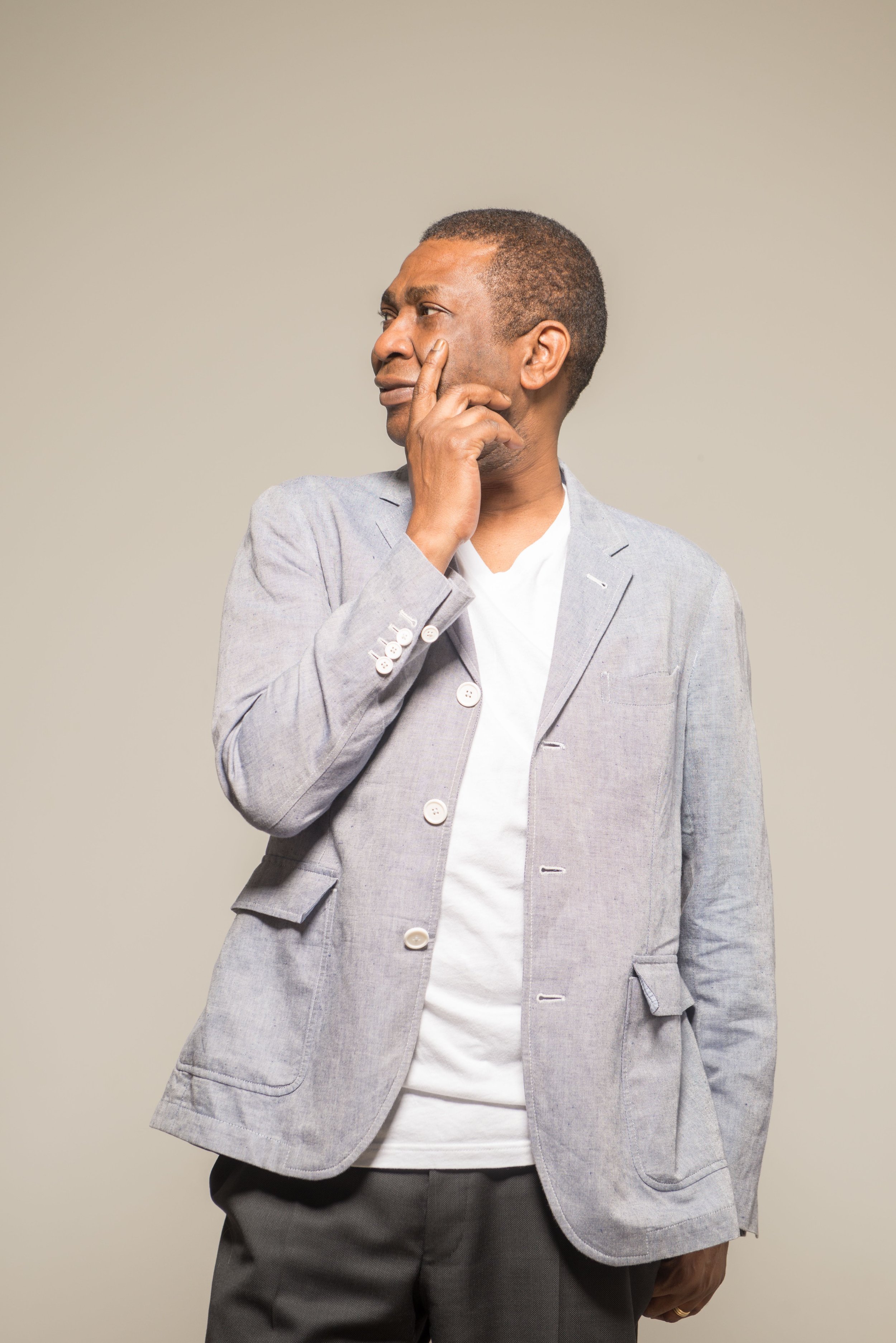


bio
YOUSSOU N’DOUR
FROM DAKAR TO THE WORLD — 50 YEARS OF MUSIC
Few artists have carried the sound, identity and spirit of Africa to the world with the reach, longevity and authenticity of Youssou N’Dour.
Singer, songwriter, composer, bandleader and cultural ambassador, Youssou N’Dour has spent nearly five decades building a musical journey that began in the streets and clubs of Dakar and grew to encompass some of the world’s greatest stages.
Yet throughout that extraordinary journey, one thing has remained constant:
Dakar is home. Senegal is the source.
Born in Dakar in 1959, with maternal roots in Senegal’s griot tradition, Youssou began performing while still a child. The griot is more than a musician: storyteller, historian and guardian of collective memory. That tradition — the belief that music carries history, identity and responsibility — would remain fundamental to his artistic life.
By his teenage years, his remarkable voice was already attracting attention in Dakar’s vibrant music scene.
But Youssou was not content simply to inherit a musical tradition.
He wanted to transform it.
THE BIRTH OF A SOUND
Following his early experience with Dakar’s Star Band, Youssou became a central figure in Étoile de Dakar before establishing Super Étoile de Dakar, the band that would accompany him through much of his career.
Together, they helped develop and popularise a new urban Senegalese sound: mbalax.
Drawing on the powerful rhythms of the sabar and tama and combining them with electric guitars, keyboards, bass, jazz, soul, Afro-Cuban influences and contemporary popular music, mbalax represented something both deeply Senegalese and unmistakably modern.
It became the soundtrack of a changing Dakar.
And Youssou N’Dour became its most internationally recognised voice.
DAKAR MEETS THE WORLD
During the 1980s, that voice began travelling far beyond Senegal.
European performances introduced international audiences to the extraordinary energy of Youssou N’Dour and Le Super Étoile de Dakar.
Then came encounters with some of the most important artists of the period.
Peter Gabriel.
Paul Simon.
Sting.
International touring followed, including participation in the historic Human Rights Now! tour alongside Peter Gabriel, Sting, Tracy Chapman and Bruce Springsteen.
Something important was happening.
Youssou N’Dour was not simply crossing from an African market into a Western one.
He was demonstrating that music deeply rooted in Dakar could communicate directly with audiences anywhere in the world.
The language might be Wolof.
The rhythms might come from Senegal.
But the emotion required no translation.
“7 SECONDS”
In 1994 came one of the defining recordings of Youssou N’Dour’s international career.
His collaboration with Neneh Cherry, 7 Seconds, became a global success.
The song crossed borders, languages, radio formats and musical categories, introducing Youssou’s unmistakable voice to millions of listeners.
But its significance extended beyond commercial success.
7 Seconds demonstrated something that Youssou’s career had already been arguing for years:
An African artist did not have to abandon his identity to become a global artist.
Dakar could speak to the world on its own terms.
AN ARTIST WITHOUT FRONTIERS
That philosophy has shaped Youssou N’Dour’s entire career.
Rather than choosing between tradition and modernity, Africa and the West, popular music and cultural heritage, he has continually built bridges between them.
His collaborators across the decades reflect an artistic curiosity without borders.
But collaboration has never meant dilution.
At the centre has always remained that unmistakable voice, the rhythmic power of Senegal and the extraordinary musicianship of Super Étoile.
The result is a body of work that has helped broaden international understanding of what contemporary African music could be.
Long before today’s explosion of African popular music across global streaming platforms and festival stages, Youssou N’Dour was demonstrating that African artists could command international audiences while remaining creatively anchored on the continent.
EGYPT
Perhaps nowhere is this philosophy clearer than on Egypt.
The album explored Youssou’s Senegalese Muslim faith through an ambitious meeting of Senegalese and Egyptian musical traditions.
It was intensely personal, spiritual and culturally specific.
And yet it resonated internationally.
Egypt won the Grammy Award for Best Contemporary World Music Album, making Youssou N’Dour Senegal’s first Grammy winner.
It was another demonstration of the principle that has accompanied his entire career:
The more deeply music understands where it comes from, the more universally it can sometimes travel.
THE MODERN GRIOT
Youssou has always understood the artist as more than an entertainer.
The griot tradition carries responsibilities: to remember, to question, to communicate and sometimes to speak when others cannot.
Across his career, his music has addressed identity, dignity, spirituality, human rights, Africa, migration, social justice and the relationship between people and power.
That engagement has extended beyond music.
He has supported humanitarian initiatives, participated in campaigns addressing issues including malaria and African development, served as a goodwill ambassador and played an active role in Senegalese public life.
For a period, he stepped away from touring and entered government, serving as Senegal’s Minister of Culture and Tourism and subsequently Minister of Tourism and Leisure.
But music remained the constant thread.
DAKAR REMAINED HOME
Perhaps one of the most important aspects of Youssou N’Dour’s international story is what he chose not to do.
Global success did not lead him to leave Senegal behind.
He remained based in Dakar.
He recorded there.
Built businesses there.
Developed media activities there.
Created opportunities there.
And continued performing with Senegalese musicians before audiences at home and around the world.
That decision has given his international career a particular meaning.
Youssou did not travel from Dakar to the world in order to escape Dakar.
He took Dakar with him.
A CAREER RECOGNISED AROUND THE WORLD
Over the decades, Youssou N’Dour’s contribution has been recognised far beyond record sales and concert audiences.
His honours include the Grammy Award, the prestigious Polar Music Prize, and Japan’s Praemium Imperiale for Music.
He received an honorary doctorate from Yale University in 2011 and an honorary doctorate from Berklee Valencia in 2024 in recognition of his contribution to sharing Senegal’s musical heritage with the world.
His recordings have received multiple Grammy nominations across several decades.
Remarkably, that story continues.
His recent album Éclairer le monde — Light the World received a nomination for Best Global Music Album at the 2026 Grammy Awards.
It is a significant symbol of the longevity of the journey: an artist whose recordings were receiving Grammy nominations more than three decades ago remains part of the international musical conversation today.
LIGHT THE WORLD
The title Éclairer le monde — Light the World — also captures something essential about Youssou N’Dour’s philosophy.
At a time of division and uncertainty, he continues to believe in music as a source of connection.
The album draws again upon the richness of Senegalese and African musical traditions while remaining open to the world.
It features instruments including kora, flute, sokou, ngoni, percussion and balafon, alongside contemporary arrangements.
Producer and musician Michael League, co-founder of Snarky Puppy, contributed bass throughout the project as well as guitars, ukulele and keyboards on selected tracks.
Once again, generations, traditions and musical cultures meet.
Not to erase their differences.
But to create something from them.
AFRICA CHANGED — AND SO DID THE WORLD
The global musical landscape into which Youssou N’Dour first ventured is radically different today.
African music is increasingly central to international popular culture.
A new generation of African artists fills arenas, dominates digital platforms and collaborates across continents.
For Youssou, this is not a threat to legacy.
It is part of the story.
The international success of today’s African artists demonstrates the enormous creative possibilities of a continent whose music has influenced the world for centuries.
The next chapter of Youssou’s career therefore looks both backwards and forwards.
There is history to celebrate.
But there is also knowledge to transmit.
50 YEARS — FROM DAKAR TO THE WORLD
Across 2027 and 2028, Youssou N’Dour will mark an extraordinary milestone: approximately five decades of musical life.
But this celebration is not intended simply as a retrospective.
YOUSSOU N’DOUR — 50 YEARS: FROM DAKAR TO THE WORLD
will celebrate a journey while opening another.
The programme is envisioned as an international celebration encompassing major concerts and festival appearances, special collaborations, archive projects, film, exhibitions, catalogue rediscovery, cultural initiatives and encounters with a new generation of African musicians.
At its centre will remain Youssou N’Dour and Le Super Étoile de Dakar — one of the great African live bands — taking the extraordinary energy of Senegalese music to audiences around the world.
The anniversary also creates an opportunity to tell a larger story.
The story of Dakar.
The story of Senegal.
The story of African music entering global popular culture.
And the story of an artist who refused to accept that becoming international required becoming less African.
THE JOURNEY CONTINUES
Fifty years is an opportunity to look back.
At the young singer in Dakar.
At Étoile de Dakar.
At the birth of mbalax.
At Super Étoile.
At the first international tours.
At Peter Gabriel and the encounters that opened new doors.
At 7 Seconds.
At Egypt.
At the Grammy.
At countless stages, cities, recordings and audiences.
But perhaps the most important question is not:
What has Youssou N’Dour accomplished in 50 years?
It is:
What can those 50 years make possible for the generation that follows?
Because the most powerful legacy is not a monument to the past.
It is a bridge towards the future.
From the rhythms of the sabar to the world’s greatest stages, from Dakar’s neighbourhoods to an international audience spanning generations, the journey has been extraordinary.
And after nearly fifty years, Youssou N’Dour’s fundamental message remains remarkably simple:
Music can cross borders.
Culture can connect people.
Africa can speak to the world in its own voice.
And the journey that began in Dakar continues.
YOUSSOU N’DOUR
50 YEARS — FROM DAKAR TO THE WORLD
THE JOURNEY CONTINUES.
gallery
press
“Ever since he burst onto the scene in Dakar, Senegal, in the early 1970s at age 12, Youssou N'Dour has been a sensation -- a musical chameleon capable of a seductive whisper or a siren's cry.” - NPR
“As the pioneer of Mbalax, he built bridges between Senegal and the world, tradition and modernity, rhythm and revolution. His influence extends beyond music into culture, politics, and global dialogue, making him not only an artist, but an institution.” - Rolling Stone Magazine