




bio
On a stage on a hill in Dakar, Senegal - the wind warm, the lights of the capital blinking below - the groove begins almost by accident. A guitar traces a looping, liquid line; hand drums answer, gently at first, then with intent. Horns lean in, languid and golden. The sprawling group of musicians - weathered elders on drums and saxophones, youthful singers, bassists and percussionists - lock into something that feels less like a song than a memory being assembled in real time.
"Sometimes I want to chase after the sun, but where the sun goes, I'm a stranger," run the lyrics in Portuguese Creole. The song - the iconic 'Utrus Horas', a blend of Afro-Cuban son, Congolese rumba and hypnotic West African griot traditions - sounds as smooth as it did when the band first recorded it in 1982. A fresh-faced crowd watches, rapt, throwing their heads back to sing along to familiar hits, including the Wolof-themed banger 'Sutukum' and the mighty French-language classic, 'On Verra Ça'.
There is new material, too - just as ageless and elegant, as complex and magical as ever. Having won over Senegal and West Africa more than half a century ago, and toured the world several times over, this veteran orchestra stays vital, continually re-energised.
"We have the conqueror spirit," says their musical director (and original member), alto-saxophonist Seydou Morou 'Thierno' Koité. "Our new younger members are fighting to keep the original sound. The older musicians are always wanting to take the path of something new."
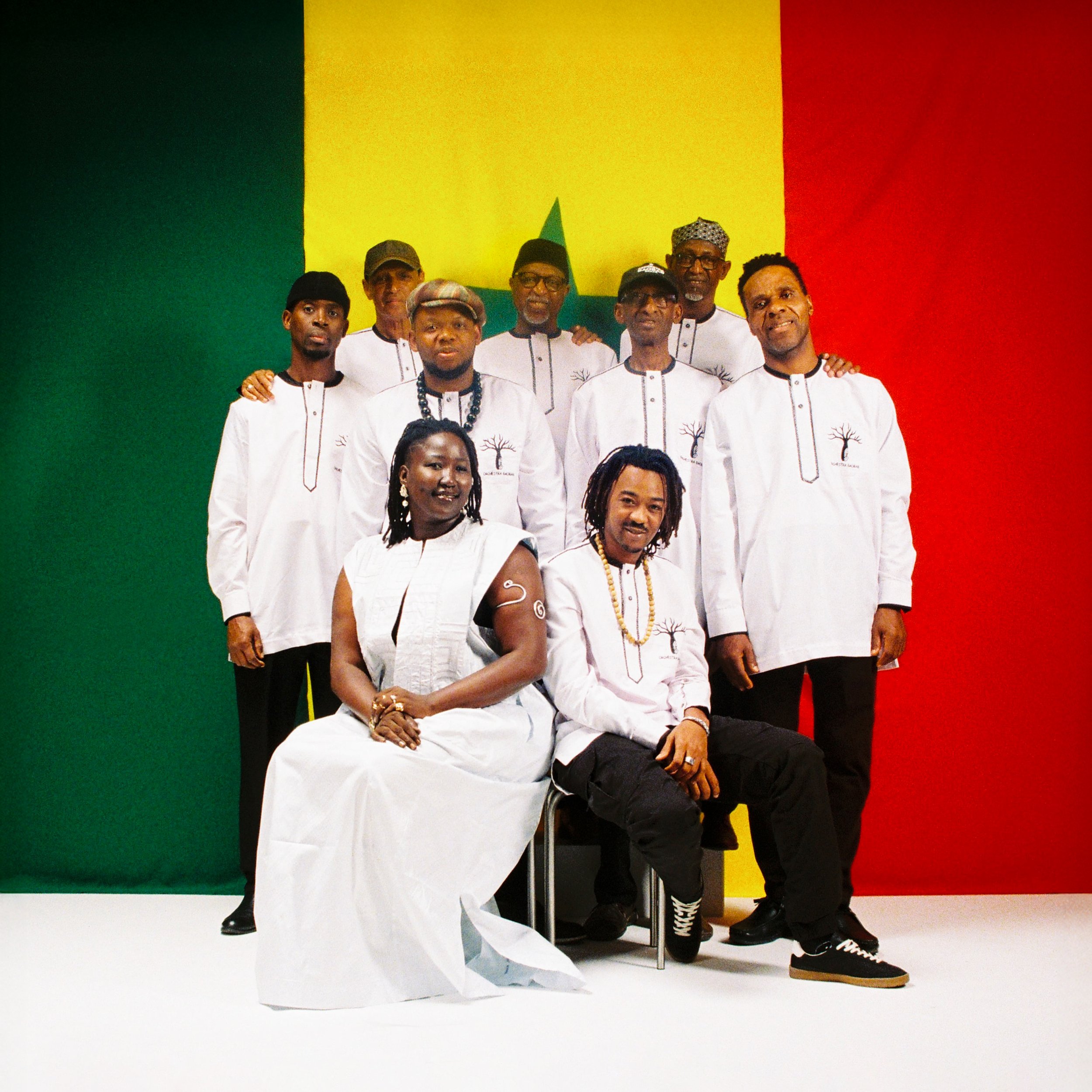
Orchestra Baobab is one of Africa's greatest bands. And now, in Senegal and beyond, more than 50 years after they first took up residency at Dakar's Baobab Club - an upmarket establishment with a strict dress code and an interior designed to resemble the hollow of a baobab tree, that hardy emblem of the savannah - a rising generation is claiming the band as its own. It's inheritance, not nostalgia. Within the group, that same multi-age handover is quietly underway, guided by a simple directive passed down from those who built it: to ensure that Orchestra Baobab will never die.
To understand how that responsibility came to rest on younger shoulders, we need to go back to a Dakar that, in the late 1960s, was humming with confidence following Senegal's independence from France in 1960. It was a time when music lovers soaked up the sounds drifting in through the city's great port - Afro-Latin styles, international pop, and Congolese rumba with its sparkling, interlocking guitars. Nightclubs flourished - dozens of them - each soundtracked by a resident orchestra that, for the most part, played the Afro-Cuban music that was all the rage, incorporating Latin instruments such as timbales and claves into their line-ups, and singing their lyrics in Spanish.
At the same time, the traditional music of Senegal was being actively championed by Léopold Sédar Senghor, the Senegalese president and cultural theorist. In 1966 he hosted the First World Festival of Negro Arts (FESMAN), a major international event aiming to unite African and diaspora artists and demonstrate the global impact of Black culture. With 45 countries represented came rhythms from West African neighbours as well as artists from Europe, the Caribbean, and the Americas.
Josephine Baker, Duke Ellington and Langston Hughes were among the 2,500 participants.
"It was the first time that Senegalese people had seen blues or jazz from the US, or music from non-African countries apart from France and Cuba," says drummer Mountaga 'Taga' Koité, Thierno's brother and Baobab's remaining original member. "We loved Cuban music because it was the sound of freedom and resistance. But this festival helped Senegal to understand that we needed to have our own voice."
A trio of exemplary musicians - guitarist Barthélémy Attisso from Togo; singer-percussionist Balla Sidibé from the Casamance region of southern Senegal; and singer-guitarist Rudi Gomis, also from Casamance (via Guinea-Bissau) - had formed a band called the Standard. A nephew of Senghor's, armed with a directive to create the best band in Senegal, folded them into the Star Band - the wildly popular house orchestra at the notoriously lively Club Miami, and a launching pad for Senegalese music icons including Youssou N'Dour.
By 1970, with the Star Band firing on all cylinders, the swanky Baobab Club opened its doors in Dakar's downtown district, a swish area characterised by colonial architecture, tree-lined boulevards, and numerous embassies. Baobab was a meeting place for a besuited urban crowd that ranged from politicians and army personnel to celebrities, judges and literati.
It needed a band with panache and smarts.
Aided by original bandleader and saxophonist Baro N'Diaye, the club owners poached five musicians from the Star Band, including Attisso, Sidibé and Gomis, as well as bassist Charlie Ndiaye and
(aforementioned) drummer 'Taga' Koité. They were joined by Moroccan-born rhythm guitarist Latfi Ben Jelloun, Nigerian clarinettist Peter Udo and seasoned Wolof singer-griot Laye Mboup.
Together they created a Senegalese evolution of Cuban music, refracted through the lens of their various ethnic and national origins.
They soon had everyone double-taking. "Baobab were different from other bands because we spent a lot of time working on harmonies and arrangements," Gomis told me in 2001, when I met him in the bougainvillea-strewn courtyard of Dakar's Cultural Centre, when the group were reforming after 15 years apart. "We had a more open attitude and better musicians. We were the first band to blend the Wolof folklore of the griots with Cuban salsa. All our members came from different regions. We were a métissage - a mix of everything."
The 13-strong crew of Orchestra Baobab were resident at the Baobab Club for seven years, a period in which they welcomed young griot singer Thione Seck into their line-up following Mboup's death in a car accident in 1974, along with saxophonist (and eventual bandleader) Issa Cissokho. Seck would sing lead vocals for five years before going on to achieve fame with his own band; another Wolof griot singer, Ndiouga Dieng - originally a backing vocalist to Laye Mboup - carried the baton forward.
Guest vocalists, too, took turns on the microphone, delivering dance numbers and love songs in Spanish, Wolof, French and Portuguese Creole.
The 1970s were a golden era for Baobab. "Everyone loved us, young, old, rich, poor. Everyone," Gomis told me while flicking through a battered photo album lined with snaps documenting their guest appearances before prime ministers and entrepreneurs, and at the selection of Miss Senegal. They released five albums on Buur records, the label owned by the Baobab Club, and enjoyed sold-out tours of Cameroon, Tunisia and Guinea.
In 1977, the year the Baobab Club closed its doors, they took up a residency at the Jandeer Night Club. There, they recorded the albums, Une Nuit au Jandeer and Ndeleng Ndeleng, whose title track, with its fierce electric guitars and galloping rhythms on bata and sabar drums, hinted at the craze of mbalax - the frenetic dance music sent gangbusters by Youssou N'Dour - about to sweep Senegal.
In 1978 Baobab toured France, playing at the wedding of fashion designer Pierre Cardin's daughter but failing to make any real impact on audiences. While there they recorded two acclaimed albums with producer Abou Sylla - On Verra Ça: The 1978 Paris Sessions and Africa 78 - that showcased their evolving sound, the former featuring the enormous hit 'On Verra Ça' ('We'll See') - a tune so ubiquitous in the region that the Guinean president would finish his speeches with a reference to its title.
Back home, Orchestra Baobab grew more popular, commanding fees of up to $4,500 for a single show. The fame stemmed, in part, from the fact that they were the first group to reconcile Dakar's chattering classes with the populace. For left-wing intellectuals, their Cuban influences helped reinforce the severing of colonial ties, while their indigenous elements were embraced by people on the street. Above all, in a country inundated with rhythms, they defied audiences not to dance.
"Our fathers were dancing to Cuban bands like Sexteto Habanera in the 1930s," said Gomis, who died aged 75 in 2022. "We felt in line with charanga, salsa, cha cha cha. Our tunes are still played on the radio every day. Young people tell me they remember them as lullabies."
In the early 1980s, after playing at the inauguration of the new Senegalese president, Abdou Diouf (a Wolof and Muslim; Senghor was Serer and Catholic) and with a fresh residency at a new restaurant, Ngalam, Baobab began releasing their albums on cassette. In 1981 came Mouhamadou Bamba and Sibou Odia, which contained the hit 'Autorail'. In 1982 their succession of releases included the oh-so-mellow Ken Dou Werente, whose track list boasted the gorgeous, bolero-friendly 'Utrus Horas'.
All of which led, perhaps inevitably, to a bootlegging frenzy.
"We took the music to another level," shrugs Taga Koité. "But it became harder for us to make a living."
For a year or so they segued into playing the sort of fashionable, hard-hitting mbalax deployed by Youssou N'Dour's Etoile de Dakar and Thione Seck's Raam Daam bands, variously turning up the funk, bringing in two female singers and forfeiting their customary wide-lapelled shirts for blue and gold lamé outfits they'd later blush about. They began drifting apart. Gomis, a qualified teacher, founded a prestigious language school. Attisso returned to Togo to restart his career as a lawyer. When they called it a day in 1987, they had some 20 albums under their collective belt.
Beyond Africa, however, Senegalese music was largely ignored until the mid 1980s, when Peter Gabriel met Youssou N'Dour in Dakar and brought his mbalax sound to the west. In his wake, and with the category 'world music' invented by London promoters to boost album sales, came Baaba Maal, Ismaël Lô and Cheikh Lô. But before them all came Orchestra Baobab, packing houses in an age when the band, not the individual, was the thing.
The story goes that a copy of Ken Dou Werente - also released as a hard-to-find vinyl album in France - was tracked down in a flea market in Paris by Nick Gold of the London-based World Circuit Records, who put it out on CD in 1989 under the name Pirate's Choice. World music fans loved it from the off. DJs Andy Kershaw, Charlie Gillett and John Peel championed Baobab on their radio shows. In 2001 World Circuit reissued it again as a double CD. The buzz was so loud that the band's remaining members - middle-aged and otherwise occupied - agreed to reform and, all being well, to record.
Gold got Attisso over from Togo for a trial jam with Gomis, Sidibé and Cissokho. They met up, greeting each other like family, in that courtyard at Dakar Cultural Centre. "If it was going to be a pointless musical exercise you'd have been able to tell quickly from the tapes," Gold told Songlines magazine in 2018 as part of its '50 Great Moments in World Music' issue, "but there was definitely chemistry there."
In May 2001 Baobab made a triumphant appearance at London's Barbican Centre, receiving a standing ovation that seemed to go on indefinitely. They began playing to large audiences around the globe - including a packed first concert in Senegal, in its former capital, St Louis, in June 2002. They then went into the studio to record Specialist in All Styles, an album that reworked old hits, introduced new songs and featured guest singers, Ibrahim Ferrer - erstwhile crooner with the Buena Vista Social Club - and Youssou N'Dour, who co-produced with Gold.
A strong return that found the band sounding like they'd never been away, Specialist in All Styles - a title taken from a sign outside a barber shop - won at the BBC Radio 3 World Music Awards and was nominated for a Grammy. It landed the band on Later... With Jools in the UK and The Late Show withDavid Letterman in the US. In 2005, they performed at the Live 8 charity concert in Johannesburg alongside Lucky Dube and Oumou Sangaré, following an introductory speech by Nelson Mandela.
In 2007, they released the glorious Made in Dakar, another seamless fusion of the traditional and the modern, including tracks such as 'Beni Baraale', a tribute to Guinea's seminal Bembeya Jazz, and 'Papa N'Diaye', a 1968 tune that marked one of the first contemporary updates of the griot repertoire. Baobab continued to tour, expanding their wide international following while also performing in Dakar, mainly at the taverna-bar garden restaurant Just 4 U, one of the capital's most popular spots.
La Belle Époque, a compilation of the band's 1970s recordings, was released on Syllart in 2009. But for several years the group were kept from recording by loss and personnel changes. Original vocalist Ndiouga Dieng passed away in 2016 and - in true griot fashion - was replaced by his son, Alpha. Barthélémy Attisso chose to put down his Les Paul and remain in Togo, making way for Beninese guitarist René 'Bolero' Sowatche - whose crystal-clear style is remarkably similar. Kora player Abdoulaye Cissokho from Casamance joined, as did Togolese saxophonist-trombonist Wilfrid Zinzou.
Under Balla Sidibé's leadership, Baobab released A Tribute to Ndiouga Dieng (World Circuit) in 2017. Thione Seck appears, returning to sing on one song - the slinking 'Sey' - for the first time in decades. So too does Cheikh Lô, who had frequently collaborated with Zinzou, lending his soulful tones to 'Magno Kouto'. The songs are mostly new, all expertly crafted and delivered under the guidance of producers Jerry Boys, Lamine Faye and Nick Gold.
Issa Cissokho died in 2019, as did Balla Sidibé the following year. Barthélémy Attisso and Thione Seck passed away in 2021, Rudy Gomis in 2022 and Charlie Ndiaye - Baobab's longtime swinging bass player - in 2023. It is tempting to imagine these departed Baobab stalwarts chilling atop a sort of Senegalese Mt Olympus - or if you like, in the skies around the 50-metre African Renaissance Monument on one of the twin hills known as Collines des Mamelles outside Dakar - watching the band carry on below. As it always has, as it always will.
"When I was small, I would watch Orchestra Baobab play live, or hear their music on the radio, or from cars or shops," says Zacharia 'Papino' Koité, the son of Taga Koité and nephew of Thierno Koité - and one of the current band's two lead vocalists. "Any day with Baobab's music in it was a happy day."
The line-up, then, has continued to evolve, while keeping things grounded in family, in a network connected by silvery threads. Percussionist Moussa Cissokho, the younger brother of Issa Cissokho, is Papino's uncle and Taga and Thierno's cousin. Rhythm guitarist Yahya Fall is formerly of Étoile 2000, an offshoot of Super Étoile de Dakar (which featured Thierno Koité). Bassist Malick Sy was handpicked by Charlie Ndiaye as his successor. Korka Dieng - the band's first permanent female lead singer - is the daughter of a respected musician close to Baobab and has known them her entire life. Add Sowatche on guitar and Zinzou on horns, and there you have it.
Orchestra Baobab - a band in peak form, disciplined and determined, stepping into a broader, newly receptive world.
There's a sense of continuity in their newfound cult status, in the crowds that flock to see them at festivals like Glastonbury and North Sea Jazz, or in those that join the returns queue at another sold out show at Olympia or the Barbican. At home in Dakar, their penchant for gigging several times a week - at Just 4 U, Le Bazoff or the outdoor restaurant on the other hill at Collines des Mamelles - keeps them match-fit and ready. The scores of younger fans that follow them from venue to venue are testament to their currency, to their ability to innovate while always retaining their essence.
"In Senegal, we are a band with a multi-generational audience," says Papino Koité. "The younger people are not so interested in DJs anymore and are coming back to live music. While their energy helps make the music feel young, they tell us that our old songs sound as if they were written today."
Now, some 60 years after Senegal hosted that festival dedicated to uniting African and diaspora artists and demonstrating the global impact of Black culture; over 50 years since Orchestra Baobab was formed as the house band for an upmarket club with an interior shaped like the inside of a tree; nearly 20 years since the band released Made in Dakar, an album that made critics' Best Of lists; and on the heels of the 2023 single '50 ANS', comes a new recording on Strut - Made in Senegal.
An album of new songs celebrating their roots, lives and loves - and old songs that sound new.
"The band will always continue," says Thierno Koité. "We are like the tree we are named after. No matter what happens, the baobab stands firm.”
Indeed, while time has taken its share and the line-up has shifted, Senegal is still home.
The sound still knows who it is.
gallery
press
“As temperatures outside drop below zero, Orchestra Baobab’s performance generates more than enough warmth on this late November night.” - Music News